In industrial production, thermal deaerators have long been the conventional water treatment equipment for removing dissolved oxygen from water. Dissolved oxygen in water can cause oxygen corrosion in boiler internals, which not only shortens the boiler's service life but can also lead to critical explosion conditions, threatening the safety of personnel and property. Traditional boiler deoxygenation methods include thermal deaeration, vacuum deaeration, and chemical dosing deaeration. Most boilers use thermal deaeration technology, which requires steam consumption. Some vented steam emissions result in significant energy waste. Membrane deoxygenation is a novel method for boiler feed water deoxygenation, offering better oxygen removal efficiency than traditional processes and lower operating costs.
The novel membrane deoxygenation technology is a membrane separation product that removes gases such as carbon dioxide and oxygen from water using the principle of diffusion. Its working principle is based on water flowing on one side of hollow fiber membranes, while a vacuum or gas sweeping (or a combination of both) is applied on the other side. The hydrophobic hollow fiber membranes have numerous micropores on their surface that allow gas molecules to pass through but block water molecules. Under the negative pressure created by vacuum or gas sweeping, dissolved gases in the water on one side of the membranes migrate through the micropores to the other side and are carried away by the vacuum or sweeping gas, thereby removing dissolved gases from the water. The deoxygenation membrane module contains a large number of hollow fibers, which increase the gas-liquid interfacial area and enhance the gas removal rate. This technology can reduce dissolved oxygen concentration to below 1 ppb and dissolved carbon dioxide concentration to below 1 ppm.
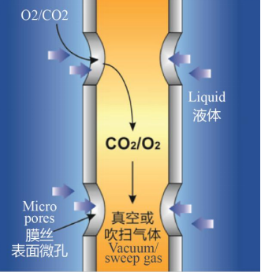
The novel membrane deoxygenation technology uses advanced hollow fiber membrane materials to efficiently remove dissolved oxygen from water through a physical diffusion mechanism. Compared to traditional thermal deaerators, this technology offers significant advantages:
Low energy consumption: Membrane deoxygenation requires no steam and operates at ambient temperature, greatly reducing energy consumption. Additionally, its minimal energy usage (primarily from a vacuum pump and nitrogen) further lowers operating costs.
Compact equipment size: The membrane deoxygenation device has a small footprint, making installation and maintenance very convenient. This allows for easier installation, relocation, and capacity expansion.
Stable operation: The deoxygenation membrane can reduce dissolved oxygen concentration to below 1 ppb, exceeding national mandatory standards, and operates reliably, making it suitable for various industrial applications.
Advanced technology: The deoxygenation membrane is woven from high�polymer materials into a hydrophobic hollow fiber array, offering high mass transfer efficiency and impact resistance while avoiding fiber breakage.
High deoxygenation efficiency: The membrane degassing efficiency is high, effectively removing oxygen from liquids at ambient temperature, suitable for a wide range of industrial water treatment applications.
Low maintenance cost: Due to its compact size and stable operation, the maintenance cost of the deoxygenation membrane is relatively low.
In summary, the novel membrane deoxygenation technology, with its advantages of high efficiency, energy savings, environmental friendliness, and compact equipment, is gradually becoming an ideal replacement for traditional thermal deaerators.
Since its establishment, Guochu Technology (Xiamen) Co., Ltd. has focused on membrane separation technology, dedicated to promoting novel separation technologies and continuously exploring new applications of membrane separation in fields such as biopharmaceuticals, microelectronics, metallurgy, chemicals, machinery, food, dairy, beverages, and the environment. The company provides targeted filtration and purification integrated solutions to meet the highly differentiated needs of various customers, improving product quality and satisfying customer requirements.