The vast ocean is a huge treasure trove. Seawater covers 71% of the Earth's surface, and deep seawater, with its unique characteristics, has attracted increasing attention. Countries such as the United States, Japan, and the Taiwan region of China have long commercialized deep ocean water in beverages, food, and other industries.
Generally speaking, deep seawater refers to the water layer at depths below approximately 200 meters, where sunlight cannot penetrate and photosynthesis cannot occur. In the water layer above 200 meters, sunlight reaches, various microorganisms thrive, and the impact of human activities is significant. However, in deep sea areas below 200 meters, the water is exceptionally clear and contains very few microorganisms. The Kochi Prefecture Deep Seawater Research Institute in Japan compared the water quality indicators of deep seawater and surface seawater from Kochi Prefecture, as shown in Table 1 below.
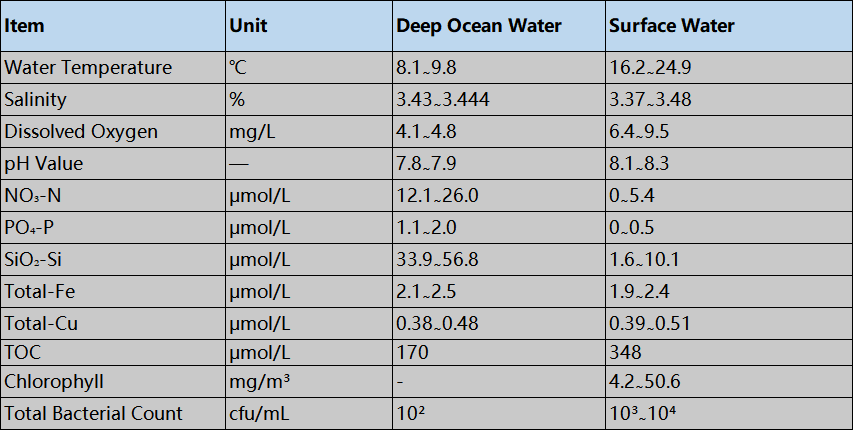
Deep seawater has the following characteristics:
Rich and stable nutrient content: Deep seawater contains over 90 types of inorganic salts and minerals (including trace elements). Since this water has flowed for a long time in the "aphotic zone" of the deep ocean without photosynthesis and unaffected by external influences, the composition of its inorganic salts and minerals (including trace elements) is very stable. It is 100% oxygen-reduced water.
Easily absorbed by the human body: After millions of years under the strong hydrostatic pressure of the deep sea, the molecular clusters of deep seawater are significantly smaller than those of terrestrial water. Its molecular bond angle is 165–180 degrees, much larger than that of terrestrial water, and is very close to the molecular bond angle of water and blood in the human body. Therefore, these molecular clusters are easily absorbed by the human body. Moreover, the nutrients (inorganic salts and minerals) dissolved in the molecular clusters, under the long-term high pressure of the deep sea, exist mostly as active free ions. Thus, while the human body absorbs these water molecules, it also absorbs the dissolved nutrients (inorganic salts and minerals).
Sterile and clean: Deep seawater in the aphotic zone is far away from the impacts of modern human civilization, free from contamination by land-based or atmospheric chemicals and pathogens, and lacks conditions for the growth of bacteria. Therefore, deep seawater is very clean, sterile natural water — 100% "green" water.
Low temperature: Since sunlight does not directly reach this depth, deep seawater does not experience the temperature fluctuations of surface water. Its temperature remains constant year-round at about 8–10°C.
In the food industry, deep seawater is widely used to produce mineral water, high-grade edible salt, soy sauce, beer, ice crystal manufacturing, and many other fields.
To better meet the diverse utilization needs of deep seawater, Guochu Technology (Xiamen) Co., Ltd. employs novel membrane separation technologies to facilitate the resource utilization and product development of deep seawater. The process flow is as follows:
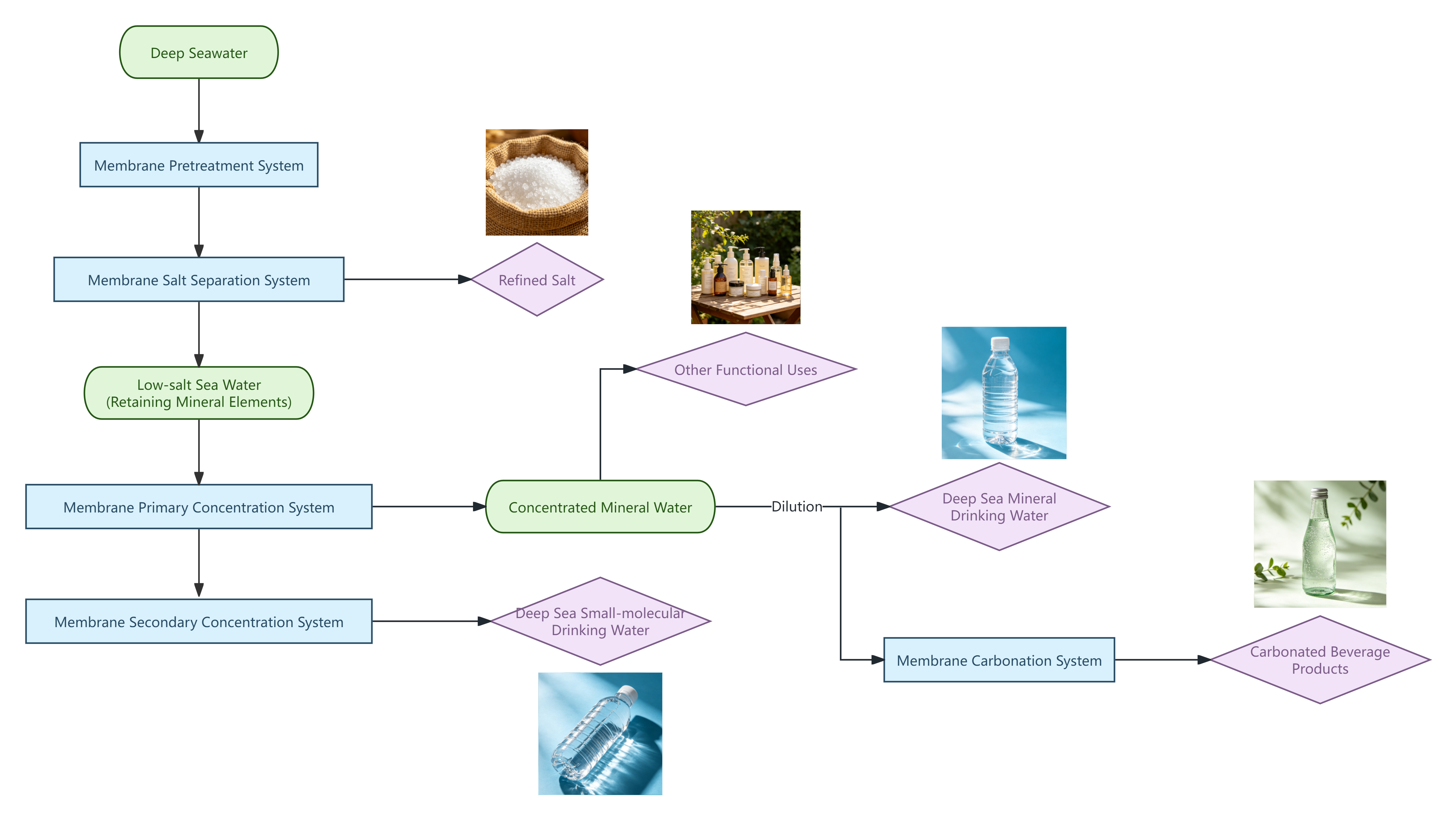
The membrane separation technologies used in this process include a membrane pretreatment system, a membrane salt separation system, a membrane concentration system, and a membrane carbonation system. First, deep seawater is pretreated using the membrane pretreatment system, then enters the membrane salt separation system, where sodium chloride is removed while other minerals and trace elements (except monovalent ions) are retained. After the salt separation system, the deep seawater enters the membrane concentration system. By adjusting the concentration factor, mineral concentrates with different hardness levels can be obtained. These mineral concentrates can be used as functional ingredients in seasonings, cosmetics, health supplements, etc. They can also be diluted, then sterilized and filtered to produce deep seawater mineral drinking water. Furthermore, by employing the membrane carbonation system, carbonated soft drinks can be produced. Water obtained after the secondary membrane concentration system meets drinking water standards and can be used to produce deep seawater small-molecule drinking water.
Although research, development, and utilization of deep seawater in China have a history of only about 30 years, ongoing technological advances and new applications will continue to unlock the tremendous resource value and economic benefits of deep seawater. Leveraging its expertise in membrane separation technology, Guochu Technology will continue to provide technical development services for deep seawater resource utilization, contributing to the sustainable development of marine resources.