Tea is a advantageous resource in China. The rise of the tea beverage industry has accelerated the pace of deep processing of tea. The haze problem in tea beverages is one of the technical challenges currently faced in tea beverage production. The haze is mostly caused by the complexation and flocculation among substances such as tea polyphenols, caffeine, soluble proteins, and pectin in the tea infusion. Traditional separation and extraction methods mainly employ mechanical filtration, high�speed centrifugation, and chemical treatment, which result in poor clarification and low product quality. An integrated membrane separation technology based on inorganic ceramic membrane technology has solved these problems: macromolecules such as proteins and pectin in the tea infusion are removed by the ceramic ultrafiltration membrane, while effective components such as tea polyphenols, caffeine, amino acids, and catechins are retained to the greatest extent, ensuring the flavor and stability of the tea beverage. At the same time, the clarified tea liquor is concentrated using a reverse osmosis membrane, replacing the traditional evaporation concentration process.
Process Characteristics
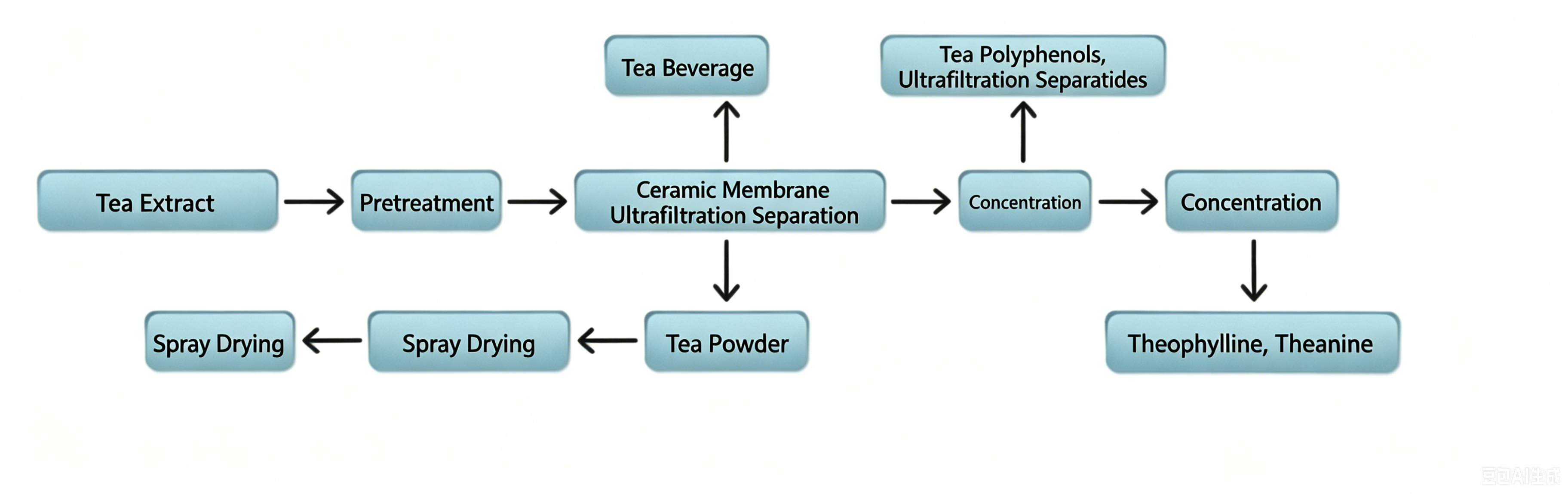
High filtration accuracy, high clarity of the filtrate, good stability, solving the "cloudiness after cooling" phenomenon.
Minimal loss of effective components such as tea polyphenols, caffeine, and amino acids, improving product purity
No addition of chemicals, pollution�free, residue�free – a green and environmentally friendly technology.
Compared with organic ultrafiltration membranes, ceramic ultrafiltration membranes can be cleaned with strong acids, strong bases (pH 0–14), and oxidizing agents, allowing thorough cleaning and regeneration, with a long service life.
The filtration process uses only pressure as the driving force for membrane separation, resulting in simple separation equipment, easy operation, and easily controllable process parameters.
Simplified process flow, short production cycle, greatly reducing production time.
Ceramic membranes have high fouling resistance, low pretreatment requirements for the tea liquor, and can maintain high flux over long periods.
Ceramic membrane elements are heat�resistant and can be sterilized with steam and oxidizing agents.
The content of impurity proteins, tannins, and pectin in the filtrate is greatly reduced, thereby reducing membrane fouling during subsequent reverse osmosis concentration, increasing flux, and extending cleaning cycles and service life.
The membrane pore size has an asymmetric distribution, allowing online backwashing.
The accompanying reverse osmosis concentration process operates at ambient temperature without phase change, avoiding the disadvantages of traditional evaporation concentration processes such as high energy consumption, significant aroma loss, high product viscosity, and easy remixing.