Wine is an alcoholic beverage produced by complete or partial fermentation of fresh grapes or grape juice, and is highly favored by consumers. Wine contains aromatic compounds, polyphenols, trace elements, and various other nutrients beneficial to human health. It helps prevent skin aging, promotes fat burning and metabolism, relieves stress, and improves sleep quality.
In winemaking, dissolved oxygen plays different roles at different stages. During the early fermentation stage and later aging stage, trace amounts of dissolved oxygen have positive effects. It not only helps fermentation proceed thoroughly and stably, effectively reducing reductive flavors caused by vigorous fermentation, but also promotes appropriate oxidation to soften tannins, improve mouthfeel, and enhance color stability. However, if the dissolved oxygen level is too high, it can cause the loss of fruity aromas, produce oxidized flavors, lead to pigment precipitation, and shorten the shelf life. After fermentation, the presence of oxygen in wine may promote browning, trigger chemical and microbiological instability reactions, and generate undesirable aroma compounds such as acetaldehyde.
To prevent excessive oxidation of wine, methods such as adding sulfur dioxide and using inert gases (e.g., nitrogen) for isolation are typically employed to reduce the intake of dissolved oxygen in wine.
To meet the requirement for controlling dissolved oxygen during winemaking, Guochu Technology has developed a novel membrane deoxygenator technology that can precisely adjust the dissolved oxygen concentration in liquids. This technology can either introduce oxygen in a bubble-free manner during fermentation to promote wine aging, or remove dissolved oxygen before bottling to extend the wine‘s shelf life, achieving dissolved oxygen levels as low as below 1 ppb (0.001 mg/L).
The membrane deoxygenator uses the principle of diffusion to remove gases such as oxygen and carbon dioxide from liquids. Its working principle is based on the liquid flowing on one side of hollow fiber membranes, while a vacuum or a purge gas (or a combination of both) is applied on the other side. The hydrophobic hollow fiber membranes have numerous micropores on their surface, which allow gas molecules to pass through but block water molecules. Under the negative pressure of vacuum or purge gas, dissolved gases in the liquid on one side of the hollow fiber membranes continuously migrate through the micropores to the other side and are carried away by the vacuum or purge gas, thereby achieving removal of dissolved gases from the liquid. The membrane deoxygenator contains a large number of hollow fibers, which expand the gas-liquid interface area and thus increase the oxygen removal rate. The deoxygenation process is fast and enables efficient, precise control of the dissolved oxygen concentration in the liquid.
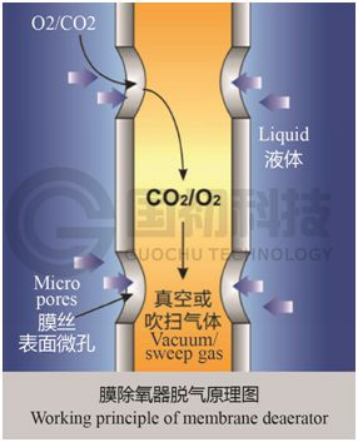
The membrane deoxygenator uses advanced hollow fiber membrane materials and achieves efficient removal of dissolved oxygen from solutions through the principle of physical diffusion. This technology offers significant advantages:
Low energy consumption: The membrane deoxygenator requires no heat steam and operates at room temperature, resulting in low energy consumption.
Compact equipment footprint: The equipment is small in size, making installation and maintenance extremely convenient. It is easy to install, move, and expand.
No chemical additives: It uses a purely physical deoxygenation method without adding chemical reagents, and can reduce dissolved oxygen to extremely low levels.
Stable operation: The membrane deoxygenator can reduce the dissolved oxygen concentration to below 1 ppb and operates stably, efficiently removing gases from the solution.
Advanced technology: The membrane deoxygenator uses hydrophobic hollow fiber arrays woven from polymer materials, offering high mass transfer efficiency and impact resistance, avoiding fiber breakage, and enabling control of the dissolved oxygen concentration in the outlet liquid.
Rapid deoxygenation: The membrane deoxygenator has high degassing efficiency, quickly removes oxygen from liquids at room temperature, responds rapidly, and precisely controls the dissolved oxygen concentration in the liquid.
Low maintenance cost: Due to its compact size and stable operation, the membrane deoxygenator has relatively low maintenance costs.
Controlling dissolved oxygen during the winemaking process is of great significance for achieving consistent and controllable wine quality and reducing the probability of wine defects. Membrane deoxygenator technology provides a powerful means for precise control of dissolved oxygen in winemaking, and will play a positive role in improving wine quality and extending shelf life.
In addition, membrane deoxygenation technology can also be used to precisely adjust the alcohol content of red wine. The adjustment process requires no addition of any chemicals and is a clean, purely physical separation process.
Since its establishment, Guochu Technology (Xiamen) Co., Ltd. has been committed to membrane separation technology as its core, dedicated to promoting novel separation technologies. The company continuously explores new applications of advanced membrane separation technologies in fields such as biopharmaceuticals, microelectronics, metallurgy, chemical engineering, machinery, food, dairy, beverages, and the environment. By addressing the highly differentiated needs of various clients, Guochu Technology provides targeted integrated solutions for filtration and purification, improving product quality and meeting customer requirements.