With the rapid advancement of biotechnology, antibody drugs, as a new class of biotherapeutics, have demonstrated tremendous potential in the treatment of cancers, tumors, infectious diseases, autoimmune disorders, and beyond. Antibody drugs are typically obtained through cell fermentation followed by separation and purification. The fermentation broth has a complex composition, containing target antibodies, host cell proteins (HCP), DNA, cell debris, culture medium residues, and other impurities. Owing to the presence of high concentrations of proteins and cell debris, its viscosity is generally higher than that of ordinary aqueous solutions, posing challenges for downstream separation and purification. Clarification of the antibody fermentation broth is the first critical step in the purification process, primarily aimed at removing insoluble particulate impurities from the cell fluid to prevent clogging of downstream chromatography columns used for purification. Conventional clarification methods, such as centrifugation, depth filtration, and tangential flow filtration, offer limited removal of soluble impurities like HCP and DNA. Therefore, the development of a chromatographic filter for antibody clarification and purification that efficiently removes HCP and DNA impurities can substantially reduce the burden on subsequent filtration and purification steps, creating value throughout the entire extraction and purification process.
The fermentation broth contains a wide variety of impurities, and the target antibody has a particle size in the intermediate range. Achieving satisfactory purification solely by mechanical retention is challenging.
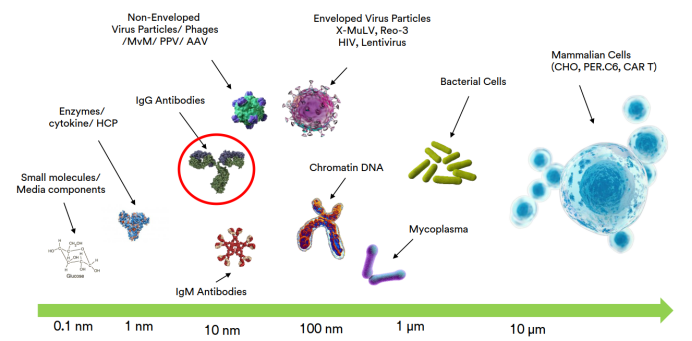
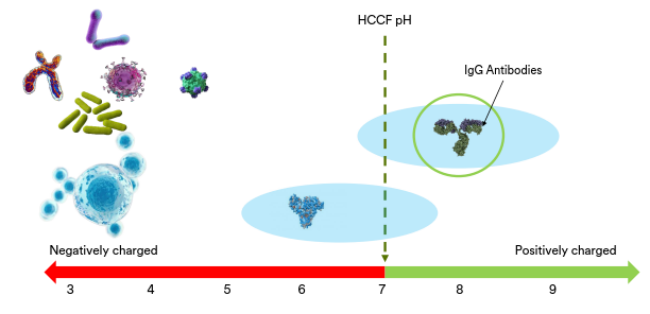
Analysis of the different components in the fermentation broth reveals that impurities and antibody proteins differ in their net charge. This difference in charge can be exploited to remove most of the impurities, thereby obtaining a target antibody product with higher purity and significantly alleviating the pressure on downstream chromatography steps.
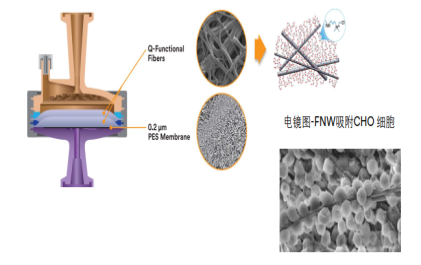
The chromatographic filter employs a composite structure made entirely of synthetic materials. The Q�group�bearing fibers within the structure efficiently adsorb cells, HCP, DNA, and other impurities, while a final 0.2 μm membrane sheet made of PES material provides an additional filtration layer to ensure that the turbidity of the effluent meets requirements. The filtrate turbidity can be reduced to below 15 NTU.
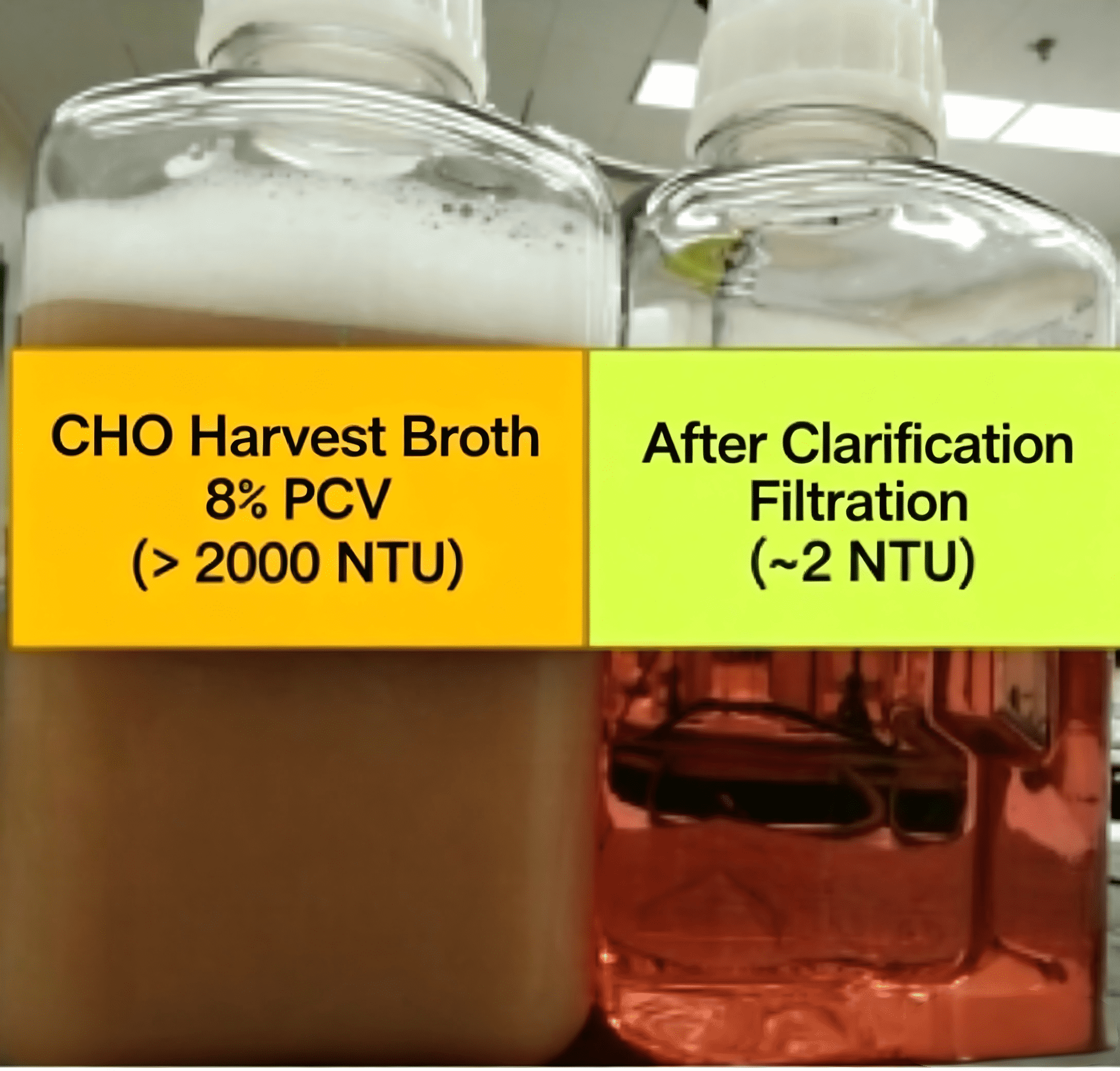
Traditional clarification processes combining centrifugation and depth filtration involve numerous steps, which can compromise product yield, typically resulting in yields of 75-90%.
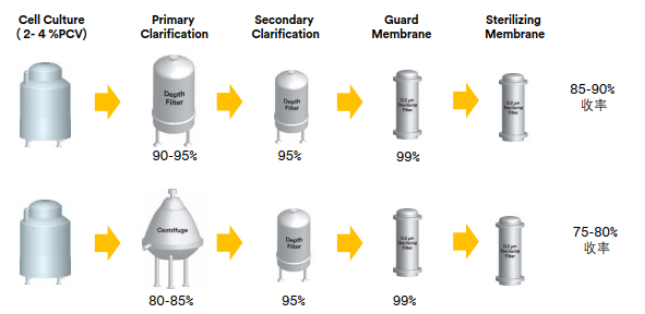
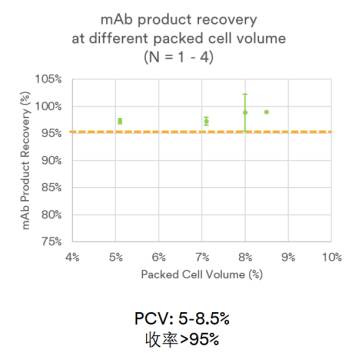
The chromatographic filter can directly process the fermentation broth without the need for pre�filtration. It integrates three clarification steps (centrifugation/depth pre�treatment + depth filtration + sterile filtration) into a single step. This significantly improves protein yield, achieving yields greater than 95% when processing fermentation broth with cell densities of 5-8.5% (PCV).
The key advantages of the chromatographic filter are as follows:
-
Fully synthetic chromatographic filter construction, eliminating the risk of leachable impurities;
-
Integration of three clarification steps into one, increasing product yield (>95%);
-
Excellent effluent quality, effectively reducing turbidity (<15 NTU);
-
Reduction of HCP content;
-
Reduction of DNA content (experimentally verified reductions: 99%, 90%, and 95%);
-
Capable of processing high-cell-density feed streams (PCV 5-8%);
-
Stable filtration performance with linear scalability;
-
Safe and easy to operate;
-
Reduces the burden on downstream polishing purification, extends the service life of downstream critical materials, and creates added value for the purification process.
Since its establishment, Guochu Technology (Xiamen) Co., Ltd. has focused on membrane separation technology as its core, dedicating itself to promoting new separation technologies. The company continuously explores novel applications of membrane separation technologies in fields such as electric power, chemical engineering, biopharmaceuticals, microelectronics, metallurgy, machinery, food, dairy, beverages, and environmental protection. Based on the highly differentiated needs of various customers, it provides targeted comprehensive filtration and purification solutions to improve product quality and meet customer requirements.