In biopharmaceutical production, purification of cell harvest is a critical process step. This process involves collecting the culture broth and performing clarification to remove cells and cell debris, thereby providing a foundation for subsequent purification of the target product. The cell culture broth contains the target product (e.g., monoclonal antibodies), cells, debris, medium components, and impurities such as host cell proteins (HCP) and DNA. The clarified filtrate contains the target product along with numerous other biological macromolecules, which will be separated during downstream purification. Cell harvest purification technologies mainly include depth filtration, centrifugation, microfiltration, and chromatographic clarification, among which depth filtration and centrifugation are currently the most widely used methods.
As upstream cell culture processes intensify, cell densities can reach up to 2.5 × 10⁷ mL⁻¹, and the content of impurities (cell debris, HCP, DNA, etc.) increases significantly, placing higher demands on downstream clarification and purification processes. The primary objectives of clarification are to remove insoluble impurities, prevent column clogging, and reduce the binding of soluble impurities to capture chromatography columns, thereby alleviating the processing burden on the chromatography step. Depth filtration technology offers precise turbidity control, high capacity, high recovery, and does not require filter aids, making it widely adopted in cell harvest purification processes.
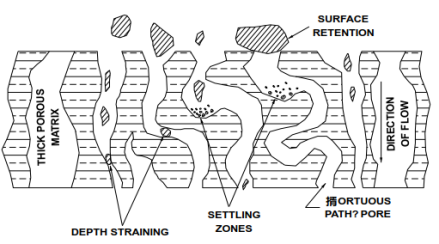
Compared with surface filtration, depth filtration has a higher dirt-holding capacity and is suitable for processing turbid feed streams. Depth filters feature a progressively tighter labyrinth-like structure that facilitates the retention of impurities of varying particle sizes.
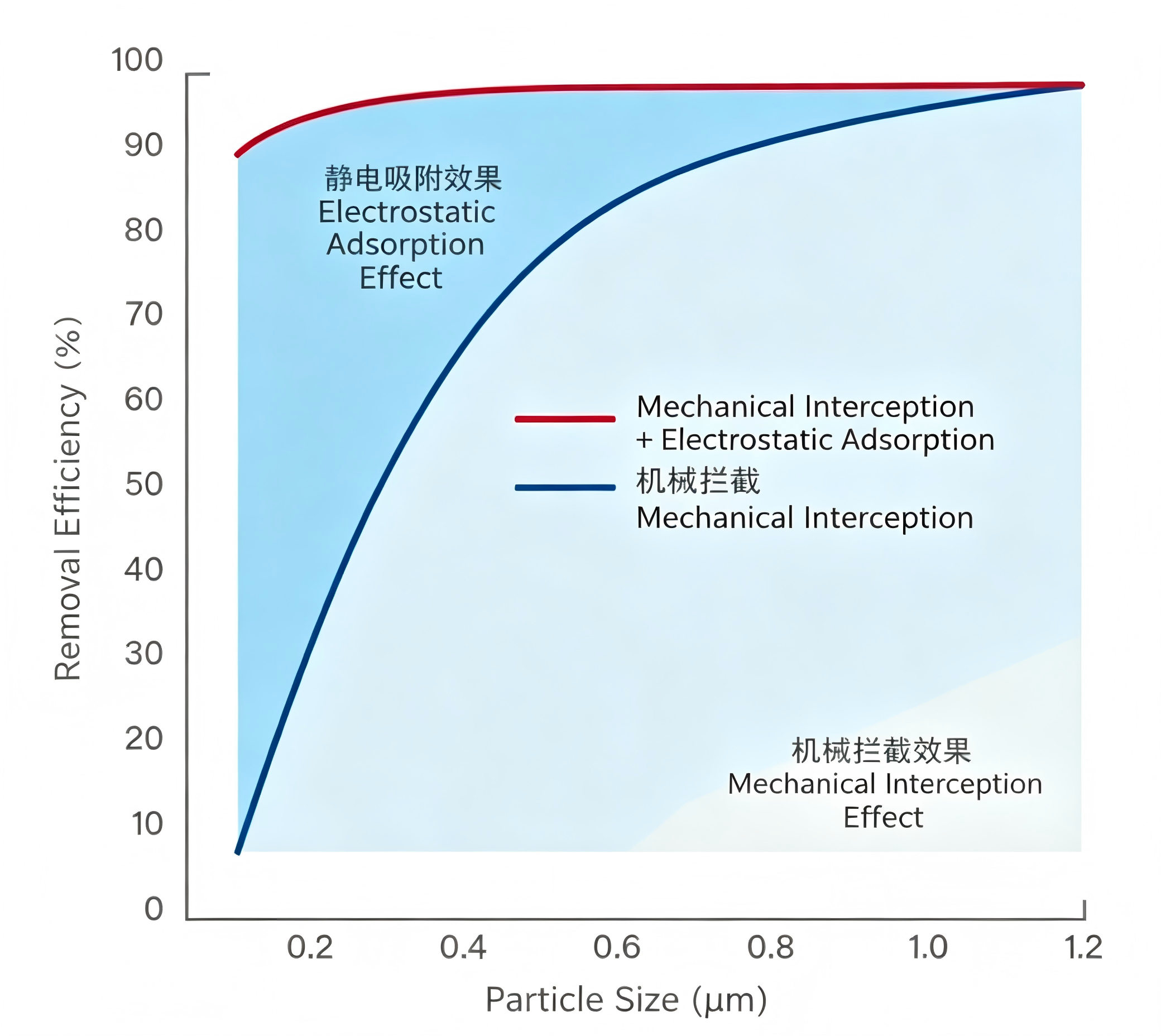
In addition to mechanical retention, depth filter cartridges also exhibit electrostatic adsorption properties. In aqueous solutions, cells, cell debris, endotoxins, contaminating DNA, and viruses all carry a negative charge. When particle sizes are smaller than the mechanical retention pore size, positively charged depth filters demonstrate significant removal efficiency for small-sized particles.
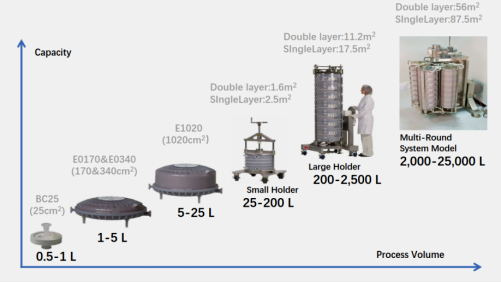
Depth filter cartridges are available in a variety of specifications and models to meet application needs ranging from laboratory testing to large scale production. They also offer good stability and excellent linear scalability.
Depth filter cartridges can be customized for different product applications, with options such as low pyrogen, low extractables, high charge, lipid-removing, and virus-removing grades.
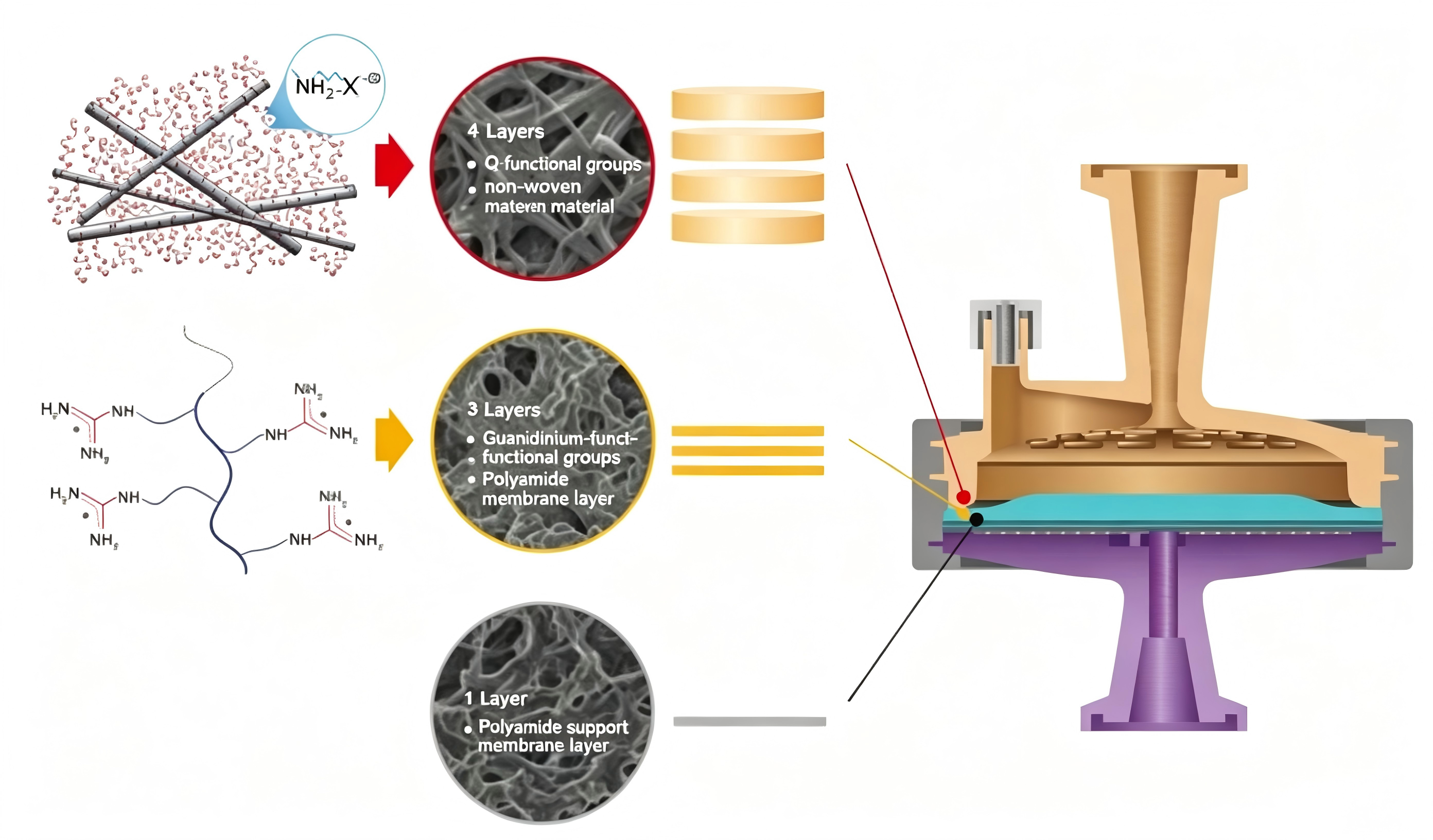
For polishing filtration of cell harvests, single-use membrane chromatography technology can be employed. The single-use membrane chromatography material consists of three components: a Q-functional nonwoven layer, a guanidine-functional membrane layer, and a support membrane layer. The Q-functional part comprises four layers of polypropylene nonwoven material with quaternary amine functional groups covalently bonded to the surface. The guanidine-functional part consists of three layers of polyamide microporous membrane with a nominal pore size of 0.8 μm, covalently bonded with guanidine functional groups. The support membrane layer is a single polyamide membrane with a nominal pore size of 0.8 μm.
During downstream purification, soluble impurities such as DNA and HCP are key targets for removal. The single-use chromatography filter employs an advanced anion-exchange membrane with high ligand density, effectively removing impurities and reducing viral levels. Its loading capacity for monoclonal antibodies (mAb) is 50-100 times higher than that of conventional chromatography resins, requiring a smaller medium volume. Moreover, its impurity removal capability (HCP ≤ 1000 ppm, DNA ≤ 100 ppb, and virus reduction) is independent of loading capacity, which can reach up to 10 kg/m², greatly simplifying the chromatography operation. The combination of high-density binding sites and a macroporous structure in the single-use chromatography filter not only provides high HCP binding capacity but also high adsorption capacity for viruses and large DNA molecules. The high-density binding sites, combined with a short residence time, enhance mAb recovery (>95%).
As a next-generation bioprocessing solution, the single-use chromatography filter is compact, has a small footprint, and offers higher capacity. It delivers greater purity and yield in downstream polishing unit operations, enabling more flexible continuous downstream processing. It effectively increases the biological yield in therapeutic recombinant protein processes, supporting biopharmaceutical companies in adopting new production technologies to achieve sustained growth and continuous innovation.
Since its establishment, Guochu Technology (Xiamen) Co., Ltd. has been committed to membrane separation technology as its core, dedicated to promoting novel separation technologies. The company continuously explores new applications of advanced membrane separation technologies in fields such as biopharmaceuticals, power, chemicals, microelectronics, metallurgy, machinery, food, dairy, beverages, and the environment. By addressing the highly differentiated needs of various clients, Guochu Technology provides targeted integrated solutions for filtration and purification, improving product quality and meeting customer requirements.