Graphene is a two-dimensional carbon nanomaterial composed of carbon atoms arranged in a hexagonal honeycomb lattice. It exhibits excellent optical, electrical, and mechanical properties. From high-performance composites in materials science to precision manufacturing in micro/nano processing, from new batteries and supercapacitors in the energy industry to drug delivery and diagnostics in biomedicine, graphene is found everywhere. It also plays a unique and important role in high-frequency electronics, environmental protection, optoelectronics, polymers, seawater desalination, solar cells, fuel cells, catalysts, and building materials. In the coming years, five major fields – conductive inks, anti-corrosion coatings, thermally conductive materials, lithium batteries, and supercapacitors – will become the main application areas for graphene.
Currently, the main methods for preparing graphene include mechanical exfoliation, solvent exfoliation, chemical vapor deposition (CVD), epitaxial growth, and redox methods. Although mechanical exfoliation and solvent exfoliation can produce high-quality graphene, their production efficiency is low, making them unable to meet the demands of large-scale industrial production. Chemical vapor deposition and epitaxial growth can produce graphene with specific structures and properties, but they suffer from high cost and complex operation, and cannot achieve large-area production. The redox method, due to its advantages of readily available raw materials and the ability for large-scale production, has become a widely used method.
The redox method uses graphite, concentrated sulfuric acid, potassium permanganate, and hydrogen peroxide as main raw materials to produce graphene through a series of complex chemical reactions. However, during this preparation process, residues such as sulfuric acid, potassium permanganate, potassium manganate, and hydrogen peroxide remain. These impurities not only affect the performance of graphene but also make it difficult to concentrate. Therefore, removing these impurities and achieving concentration of graphene has become a technical challenge that urgently needs to be addressed worldwide.
Leveraging its deep expertise in novel separation technologies accumulated over many years, Guochu Technology (Xiamen) Co., Ltd. has successfully applied novel separation technology to the deacidification, impurity removal, purification, and concentration steps in the graphene preparation process, providing an innovative solution to this challenge.
Main application process of novel separation technology in the preparation of high-purity graphene:
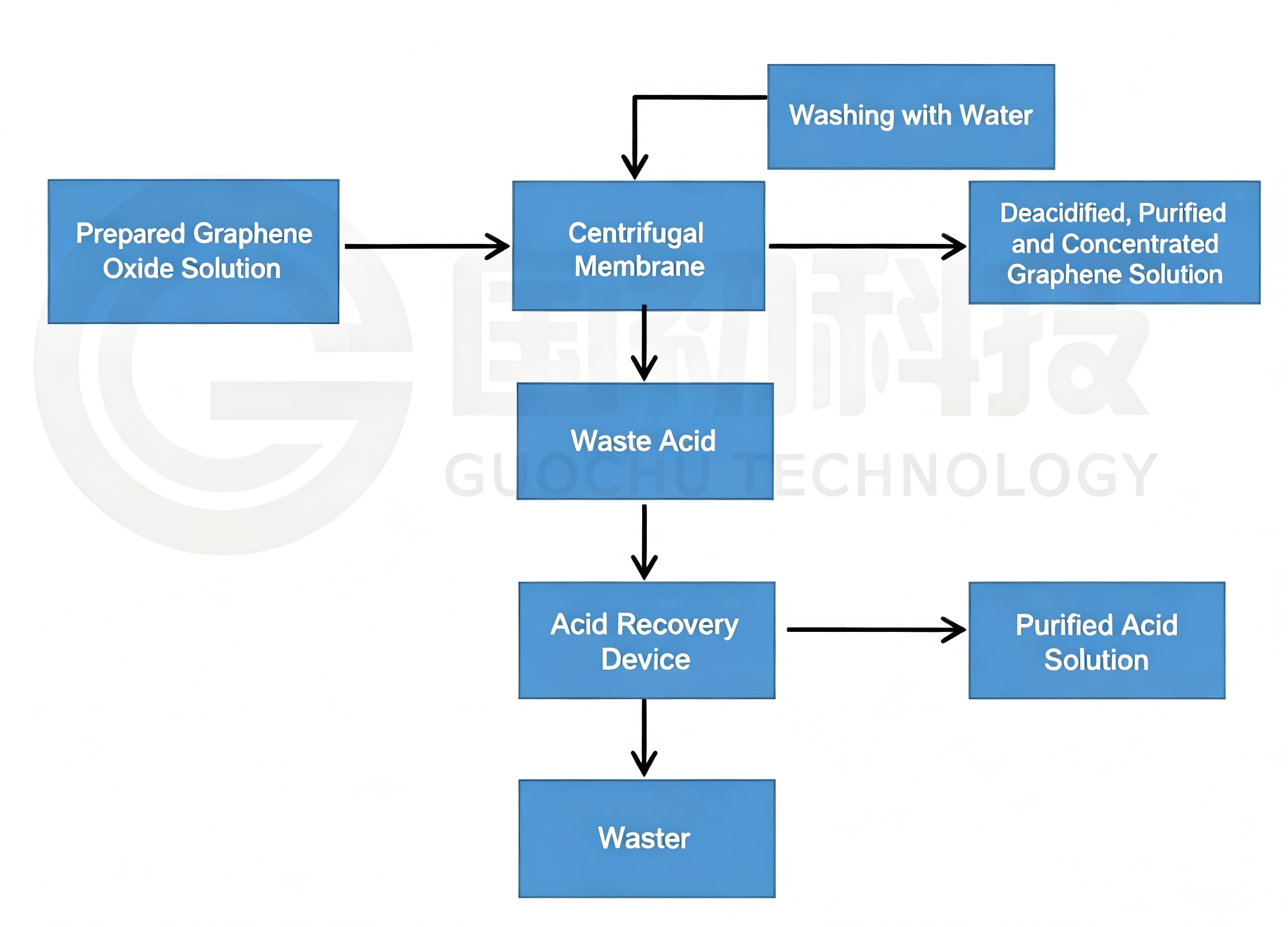
This technology uses an innovatively developed centrifugal membrane technology to achieve efficient and rapid removal of concentrated sulfuric acid/hydrochloric acid. During deacidification, it can also effectively remove manganese and potassium ions, greatly improving the purity of graphene. By adding pure water for washing, residual impurities can be further removed, obtaining a high-purity graphene solution. The centrifugal membrane technology not only achieves deacidification but also effectively concentrates the deacidified graphene solution, increasing the graphene concentration to meet the needs of different application scenarios. In addition, Guochu Technology's acid recovery technology also plays an important role, effectively recovering and utilizing the waste acid generated during the elution process, thereby reducing production costs, minimizing environmental pollution, and achieving resource recycling.
At present, Guochu Technology (Xiamen) Co., Ltd. continues to dedicate itself to the application and promotion of novel membrane separation technologies. Leveraging its extensive experience in specialized membrane applications accumulated in industries such as pharmaceuticals, chemicals, food, beverages, petroleum, petrochemicals, and nuclear energy, the company can deeply research and develop technologies and equipment tailored to the specific separation requirements of clients based on their process needs, helping more industries achieve technological upgrading and innovative development.