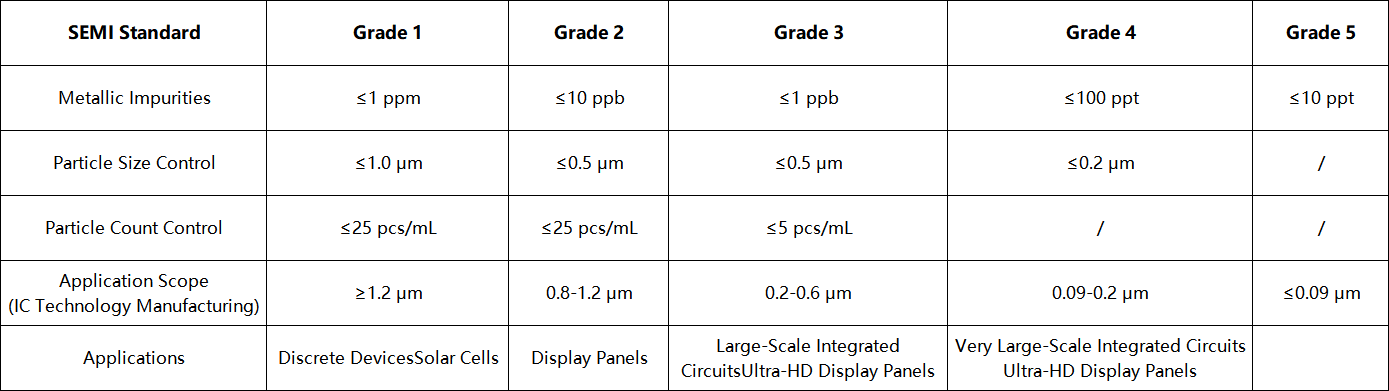
Ultra-clean high-purity chemicals are indispensable key basic chemical materials in the development of microelectronics technology. They are mainly used in the fields of semiconductors, flat panel displays, photovoltaic solar cells, as well as in the manufacturing of microelectronic and optoelectronic devices. With the rapid advancement of microelectronics technology, the requirements and standards for ultra-clean high-purity reagents are constantly increasing. The purity and cleanliness of ultra-clean high-purity chemicals have a very significant impact on the yield, electrical performance, and reliability of integrated circuits (ICs). Different line-width IC fabrication technologies impose strict requirements on metal impurities and particles in ultra-clean high-purity chemicals. Metal impurities such as Au, Pt, Fe, Ni, Cu, as well as alkali metals like Na and K, can seriously affect the performance of electronic components. Therefore, the removal of metal impurities and particles is a critical step in the preparation of ultra-clean high-purity chemicals, as shown in the table below.
SEMI International Standards Grades and Applications
Ultra-clean high-purity chemicals are used throughout the entire IC manufacturing process. In wet process steps, metal impurities in the chemicals can harm the electrical performance of electronic components. Even extremely trace amounts of metal impurities can seriously affect the product quality of semiconductors. For example, Au, Pt, Fe, Ni, Cu, etc., are fast-diffusing species in silicon wafers, affecting the reliability and threshold voltage of components, potentially leading to low breakdown and defects. Alkali metals such as Na and K can diffuse into the oxide film, causing leakage and low breakdown hazards. P, As, Sb, Al, etc., are shallow-level impurities in silicon wafers with diffusion effects, affecting the number of electrons and holes. As the integration density of ICs continues to increase, the requirements for metal ion content in ultra-clean high-purity chemicals are becoming increasingly stringent.
During the preparation and application of ultra-clean high-purity chemicals, the presence of particles is an issue that cannot be ignored. These particles may originate from raw materials, the production environment, or contamination during processing. They not only harm the yield and reliability of ICs but also affect the electrical performance and stability of electronic components.
At present, common technologies for preparing ultra-clean high-purity reagents both domestically and internationally mainly include distillation, rectification, ion exchange, recrystallization, chemical treatment, and membrane treatment. Membrane treatment is a physical separation process that requires no heating or addition of any chemical reagents. It is an effective method for removing trace metal ion impurities. Based on years of experience in membrane technology applications, Guochu Technology has developed a process for removing metal ions from ultra-clean high-purity chemicals, capable of achieving metal ion levels as low as <50 ppt.
In addition to metal ions, particle control in ultra-clean high-purity chemicals is equally critical. Targeting the characteristics of ultra-pure chemicals, Guochu Technology adopts high-precision particle removal ultrafiltration membrane modules (with precision up to 5 nm) to effectively remove particles ≥0.2 μm, meeting the requirements of SEMI Grade 4/5 standards.
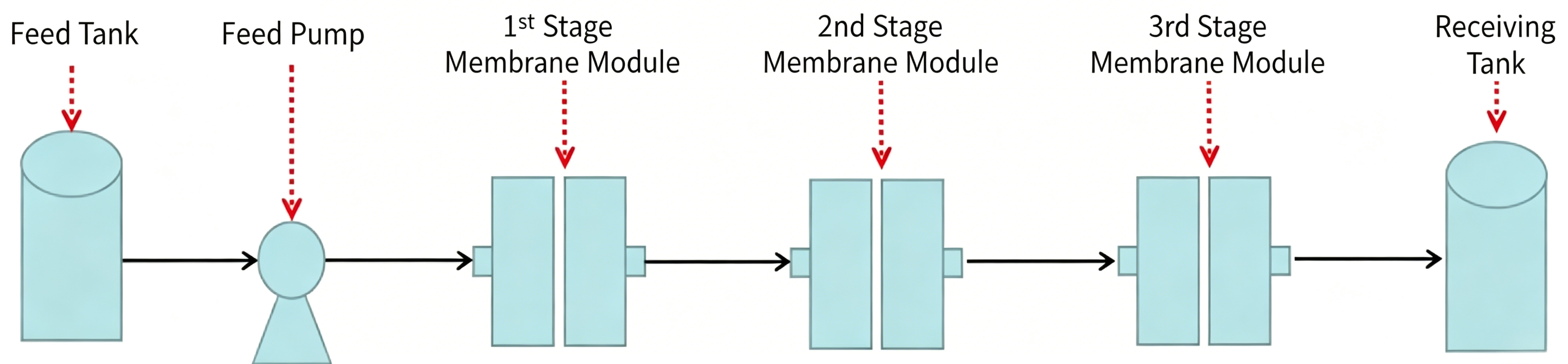
To avoid contamination from leachables of contacting components, all parts that come into contact with ultra-clean high-purity chemicals in the process flow must be made of high-purity materials. The primary membrane module can reduce metal impurity content to the ppb level, the secondary membrane module can reduce it to the ppt level, and the tertiary membrane module serves as final filtration to ensure the solvent is free of particles, with precision up to 5 nm. It also helps degas bubbles, improving the stability of the chemicals. This process has good removal efficiency for metal impurities such as K, Na, Ca, Cu, Fe, and Mg.
Compared with traditional distillation processes, this process has a smaller equipment footprint, is very easy to operate, features a sealed system, consumes less energy, and is environmentally friendly. It can be used not only for the production of ultra-clean high-purity chemicals but also for the purification of other high-purity reagents in semiconductor manufacturing processes, such as resins, polymers, and photochemical products. It can achieve ppb-to-ppt level removal of metal ions while simultaneously completing particle control, significantly improving the overall quality of ultra-pure chemicals.
In addition to metal ions, particle control and bubble removal in ultra-clean high-purity chemicals are equally critical. Targeting the characteristics of ultra-pure chemicals, Guochu Technology can also provide degassing membrane technology for chemical solutions. This technology quickly removes bubbles or dissolved gases (such as O₂, CO₂) from liquids during the process flow using chemical solutions, preventing bubble interference in processes such as photolithography and etching.
This technology has been widely used in the purification of semiconductor photoresists, electronic-grade solvents, and other products, ensuring that chemicals are free of particles and bubbles during transportation and use, thereby improving process stability.
Since its establishment, Guochu Technology (Xiamen) Co., Ltd. has been committed to membrane separation technology as its core, dedicated to promoting novel separation technologies. The company continuously explores new applications of advanced membrane separation technologies in fields such as microelectronics, metallurgy, chemical engineering, machinery, food, dairy, beverages, and the environment. By addressing the highly differentiated needs of various clients, Guochu Technology provides targeted integrated solutions for filtration and purification, improving product quality and meeting customer requirements.